Photosynthetic Quantum Coherence
New spectroscopy work confirms that light-harvesting complexes exploit quantum coherence to transport energy with near-unit efficiency — a biological role for superposition once thought impossible outside the lab.
Brought to you by Silicon Valley Quantum and Advanced Computing

New spectroscopy work confirms that light-harvesting complexes exploit quantum coherence to transport energy with near-unit efficiency — a biological role for superposition once thought impossible outside the lab.
Researchers are repurposing the double helix as a room-temperature quantum detector, using proton tunneling and spin correlations to read out molecular states at unprecedented sensitivity.
From microtubule vibrations to ion-channel correlations, the debate over quantum biology in the brain is moving from speculation to testable, experiment-backed models.
Two fridges joined and cooled below 15 mK — the architecture needed to wire hundreds of chips together. Starling, at 200 logical qubits, is still dated 2029.
Peer-reviewed evidence that gate-model error correction can run at significantly lower hardware overhead as systems scale. Annealing's incumbent now has a gate-model story.
Individual atoms trapped by laser light from a photonic integrated circuit — a world first that removes one of the central bulk-optics barriers to scaling neutral atoms.
Connecting research breakthroughs to the companies building the quantum future.
| Company | Ticker | Approach | Latest Metric | Signal |
|---|---|---|---|---|
| IonQ | IONQ | Trapped Ion | +287% YoY | Record Q2 revenue of $80.1M; reaffirms 100% organic growth target for FY2026 (Aug 5) |
| Quantinuum | QNT | Trapped Ion | +279% YoY | First earnings since IPO; near five-nines logical fidelity on Helios, Oracle Cloud deployment deal (Aug 11) |
| IBM | IBM | Superconducting | $10B program | Joined and cooled two cryogenic modules — first step to linking hundreds of chips for Starling in 2029 (Aug 19) |
| D-Wave Quantum | QBTS | Annealing + Gate | Nature paper | Dual-rail hardware demonstrates gate-model error correction at materially lower overhead (Aug 5) |
| Rigetti Computing | RGTI | Superconducting | $5.1M Q2 rev | Operating loss $28.1M; roadmap progress plus new U.S. government support (Aug 6) |
| Pasqal | PRIV | Neutral Atom | World-first | Atoms trapped with light from a photonic integrated circuit — control moves on-chip (Aug 10) |
| Q-CTRL | PRIV | Software / Control | 2× prior best | Ran a >100-qubit Quantum Fourier Transform on IBM hardware via new compilation strategy (Aug 10) |
| Alphabet (Google) | GOOGL | Superconducting | Roadmap | Quantum AI continues scaling post-Willow error-corrected logical qubit work |
This month's read: the sector's commercial line and its physics line finally moved together. IonQ (+287% YoY, $80.1M) and Quantinuum (+279% YoY, its first report since the IPO) both posted growth that would be notable in any industry, while IBM spent August on cryogenic plumbing rather than qubit counts — a tell that the hard part is now systems engineering, not physics demos. D-Wave's Nature paper gives it a second, gate-model story, and Pasqal's on-chip trapping quietly removes a bulk-optics bottleneck from the neutral-atom roadmap. Watch two things next quarter: whether Quantinuum's Oracle Cloud deployment converts into recurring utilization, and whether Rigetti's $5.1M of revenue against a $28.1M operating loss narrows on the back of new U.S. government support.
This section is editorial analysis of publicly available market data, not financial advice. Always do your own research before making investment decisions.
Leading off: Modular Cryogenic Integration for Multi-Chip Quantum Systems.
Two cryogenic modules joined into a single environment below 15 millikelvin. Not a physics result — an engineering one, and it is the gate on every roadmap that assumes hundreds of linked chips.
Erasure-biased dual-rail hardware cuts the overhead of gate-model error correction as systems scale. Peer-reviewed, and a credible second platform for a company known for annealing.
A compilation strategy that suppresses routing overhead and error accumulation runs a QFT twice the size of any prior hardware demonstration. Phase estimation gets closer to useful.
The papers we track focus on what's coming after the transistor, the qubit, the digital gate. But there's a parallel question worth flagging for readers in or near the job market: what comes after the technical-task layer of hiring, now that AI compresses much of it?
Three signals from the last quarter converge on the same trend.
Gartner's 2026 Strategic Predictions, released in October, predict that "atrophy of critical-thinking skills, due to GenAI use, will push 50% of the global organizations to require 'AI-free' skills assessments" through 2026. Gartner's analysts explicitly anticipate a secondary market emerging for tools that "isolate human reasoning ability."
87% of companies now use AI somewhere in their hiring funnel. The AI screens resumes earlier and faster than before — meaning the human-evaluated phases, particularly cognitive testing, carry more weight than they did two years ago.
Quality-of-hire has overtaken cost-per-hire as the top-ranked HR metric in major industry surveys.
The pattern: as AI compresses the technical-task layer of work, the cognitive-screening layer of hiring is being upgraded, not removed.
One tool worth knowing about in this space is skillbricks.app — a prep tool focused on the Predictive Index Cognitive Assessment, the 12-minute timed reasoning test that companies like Stryker, Capital One, BCG, and Bain use to filter candidates before final interviews. Code EARLY50 is active for Quantum Brief readers.
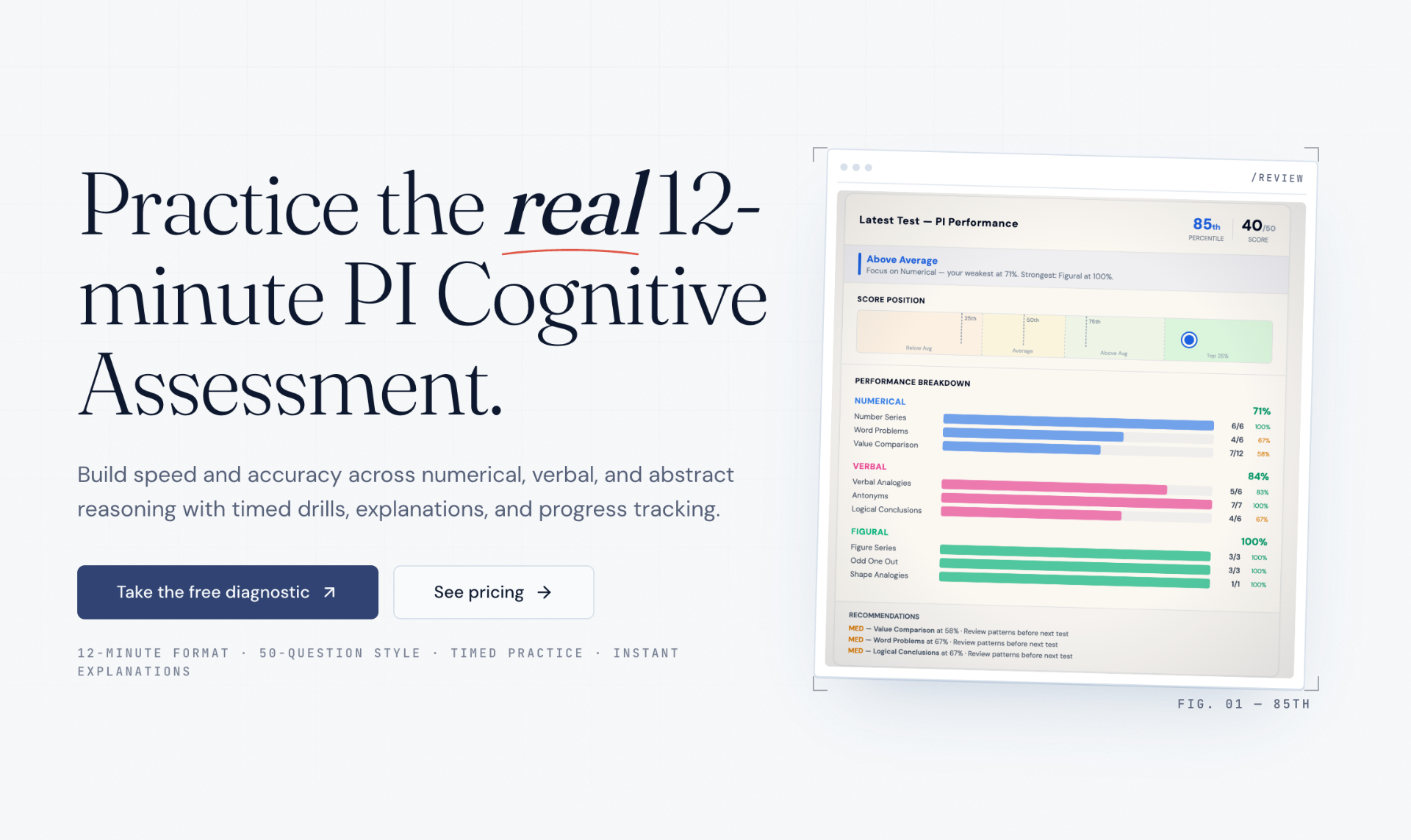
As AI flattens the technical-task layer of work, the signal that still separates candidates is raw cognitive throughput: timed reasoning, pattern recognition, working memory under pressure. Cognitive screens already gate roughly 70% of knowledge-worker hires at firms like BCG, Bain, Capital One, and Stryker — and most candidates fail not on intelligence but on format unfamiliarity.
Skillbricks is a focused prep tool for the Predictive Index Cognitive Assessment — the 12-minute reasoning test used as a pre-interview filter. Practice under the same time pressure, learn the question shapes, and walk in calibrated.
One email. No threads, no takes, no ads. Unsubscribe in one click.
Two cryogenic modules joined and cooled below 15 mK into one shared environment — the architecture required to link hundreds of quantum chips.
Erasure-biased dual-rail hardware delivers gate-model error correction at significantly lower overhead as systems scale.
A new compilation strategy suppresses routing overhead and error accumulation, running a QFT twice the size of any previous hardware demonstration.
Individual neutral atoms trapped by light generated on a photonic chip, replacing bulk free-space optics — a world first for scalable qubit control.
Synthetic DNA paired with a semiconductor channel stores and processes information in the same place, cutting energy per operation by roughly two orders of magnitude.
A systematic error model for combinatorial DNA encoding, plus correction schemes that hold density while tolerating realistic synthesis and sequencing noise.